Blog
The Illinois Municipal Program
April 29, 2025

The opinions shared in this op-ed reflect the views of the author, not the official opinions of Arena. If you would like to submit an op-ed sharing campaign best practices, lessons learned, or thoughts on how to rebuild our democracy, submit your ideas here >>
With Republicans tearing apart the federal government and state legislatures across the country enacting regressive policies, in many cases municipal offices are the “last blue wall” we have. There are over 70,000 non-partisan offices on the ballot in 2025 that impact peoples’ everyday lives but don’t get the attention that national elections do. As campaigners in the progressive ecosystem, we have an opportunity to make an impact on these races and elect good people to office who will make their communities better.
Local municipal elections are different from even-year elections in many ways. Turnout is low – sometimes under 10% in places, and even the people who do vote need to do research to find out who to vote for in a non-partisan election. And most people running for local office are entirely self-funded, with campaign budgets under $1000, and lack experienced campaign staff.
In an effort to fix these problems, the Winnable team partnered with the Democratic Party of Illinois to help run a program supporting almost 300 candidates running for local office in the April 1st election, and won 80% of our targeted races.
I know what you’re thinking: IL is a blue state, it’s expected to win most of these races in a low turnout election. But we ran candidates – and won – in some of the reddest parts of the state, places where Democrats typically only get 25% of the vote. There are opportunities to elect good candidates in any state, in any district, if we run the right kinds of campaigns.
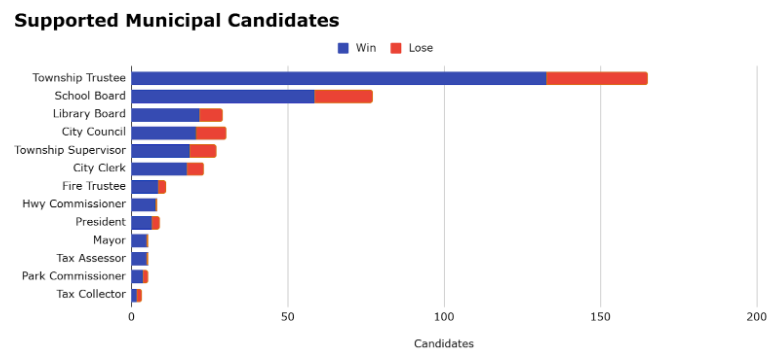
At the end of the day, we run campaigns to elect candidates who will make people’s lives better. One of the most fundamental ways we can do that is at the local level – voters care about their cities, schools, libraries, and parks.
These victories last month pushed back against conservative extremists running for local offices like school boards, library boards, city clerks, and mayors. It’s also helped build a bench of candidates in places where Democrats often struggle to win partisan elections. And it’s been an amazing organizing opportunity for activists on the ground to continue to do outreach to voters and volunteers.
We believe that anyone can run this kind of program in any kind of district – whether it’s another state party or an independent organization. So we’re sharing some lessons learned about how to run winning municipal campaigns – and we want to help provide the tools to make it easy! Reach out to AJ at aj@winnable.app if you want to learn more or talk about how we can help you!
One of the biggest challenges was just finding out who was running for office in which districts – and matching that data to the voter file to allow us to target voters with the info about the right candidates. The ILDems team filed hundreds of FOIAs to collect data on candidates filed for office, but that was only the first step. The candidate names had to be cleaned, and the district names had to be matched to the voter file in order to target outreach to the right voters in the district. This was a crucial step to ensuring we could run a centralized statewide program.
Now, we’re partnering with the Democratic Municipal Officials to make our spreadsheet templates available to state parties across the country to help collect and categorize candidates for local office – and match that data to the voter file.
County parties, local elected officials, labor unions, and grassroots groups all have deep insights into their neighborhoods – who comes to school board meetings, who has run for office before, and who posts hateful rhetoric on social media. Their work was invaluable in helping us determine who was a candidate who “shared our values” vs one who we should actively oppose.

Local municipal elections are often low turnout and low information by design: April 1st in an odd year is a difficult time to run a campaign. Especially when these offices are technically non-partisan, even solid “base” Democrats not only need reminders to vote, but also instructions on whom to vote for. Constituencies who normally don’t get outreach from campaigns because they always vote for the candidate with a “D” next to their name would need help in this kind of election.

Our principle was that every piece of communication that went out needed to have candidate names on it, otherwise we risk our voters casting ballots for conservative candidates. Just telling voters to cast their ballot for candidates who share their values or support policies they care about isn’t enough when they have no information about the candidates themselves.
And because we didn’t spam voters and instead offered them helpful information, we had incredible anecdotal feedback from our outreach.
We sent text messages to voters that had unique graphics for the district they live in. We created over 300 unique graphics – and we have templates and code ready to use to create these again for other campaigns!
From mail to digital ads to text messages, we knew that we could leverage campaign tactics that might be out of reach for the average downballot campaign because of funding or staff capacity constraints. By pooling resources and using our shared expertise at a statewide level, we could drive voters to cast ballots for our candidates.
All of our communication, even the text messages with graphics, included a link to our microsite, Vote Local Illinois, which allowed voters to enter their address and see the list of candidates to support or oppose. Over the course of the 3 weeks we had the tool live, we had over 45,000 lookups across the state. We had more lookups than the margin of victory in many of our closest elections.

Because these were non-partisan elections, some candidates were particularly nervous about having the ILDems do outreach on their behalf, an understandable concern in some deep red districts. We focused our outreach on people who are solid Democratic voters, ones who would be receptive to messaging from the Democratic Party but needed an extra push to vote or extra information on the candidates. We targeted voters with high Democratic party support scores who wouldn’t have any backlash effect from hearing from a partisan organization.
This still left a large swath of voters that ILDems couldn’t message to, but the candidates themselves were the perfect messengers for those voters. They could speak to local issues that the party may not be the best messenger on, while avoiding any negative effects of directly associating themselves with the party brand.
Local elections have a massive impact on communities across the country, and are a place where the media environment is less saturated and our campaigns can have an even bigger impact. For a fraction of the cost of a congressional or statewide campaign, we can win dozens or even hundreds of elections to build a bench and make people’s everyday lives better.
AJ Kahle is the founder of Winnable. If you want to learn more about Winnable’s research and tools, reach out to AJ at aj@winnable.app.